

'Annie Hall' Is Better Than 'When Harry Met Sally' (and We All Know It)
Spend any amount of time in online film spaces, and you’ve inevitably seen people spread this quote of Orson Welles talking about Woody Allen: “To me, it’s the most embarrassing thing in the world — a man who presents himself at his worst to get laughs, in order to free himself from his hang-ups. Everything he does on the screen is therapeutic.” This aptly describes Annie Hall (1977), his most well-known film, but it also describes the works of many other directors in the cultural moment of the 1970s — when cinephile culture was at its peak in the US, the auteur director was king, and anti-intellectualism hadn’t yet set in. (Ironically, this moment was killed the same year with the release of Star Wars.) Twelve years later, Nora Ephron wrote while Rob Reiner directed When Harry Met Sally, a sort of Annie Hall for the 80s, one that is more commercial and therefore more surface level and optimistic.
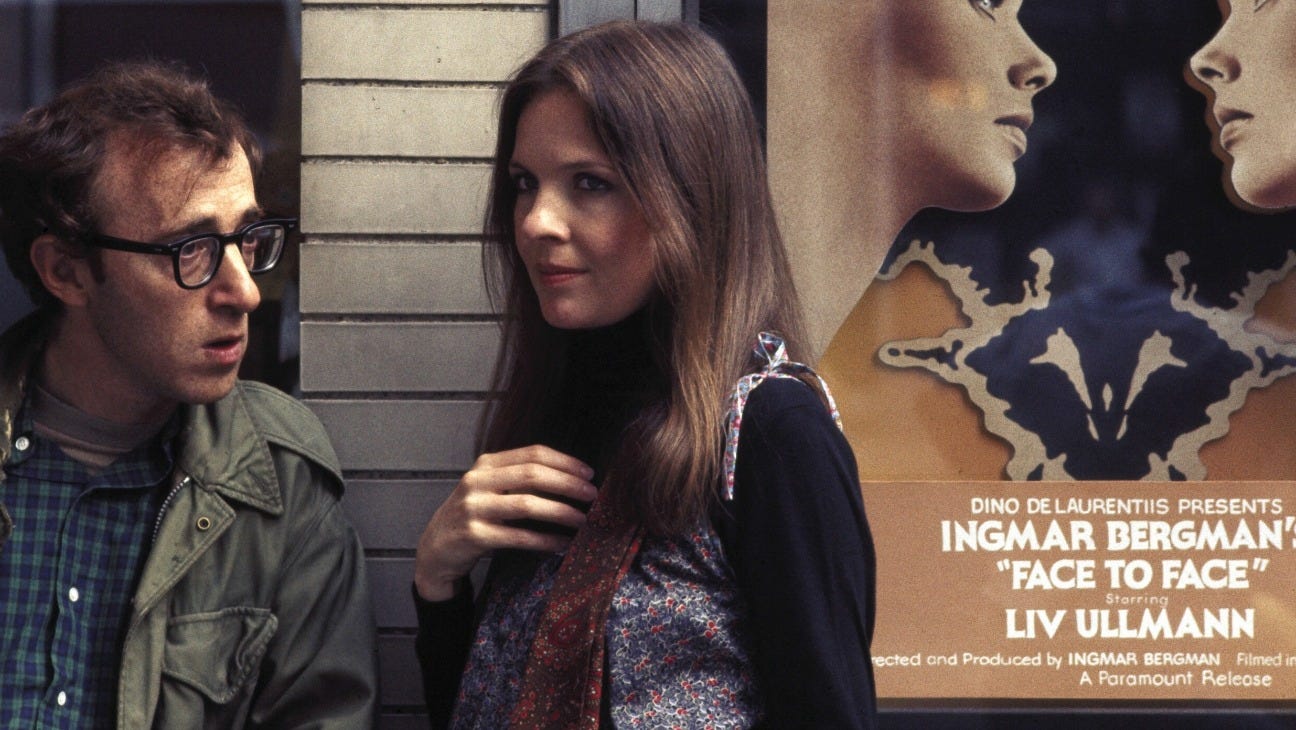
Annie Hall follows Alvy Singer (Allen) as he looks back on his failed relationship with the titular character (Diane Keaton), wondering what led to their break-up. Known for his self-referential characters, Alvy is just Allen: a socially awkward, neurotic, New York Jewish intellectual, comic and cinephile. Trying to make it as a singer, Annie is just as socially awkward with hang-ups of her own, but she wonders if she’s smart enough for the well-read Alvy. When they visit Los Angeles after they’ve been together for a while, they mutually decide that the relationship between them is over, but Annie realizes that she likes the City of Angels more than New York, an unforgivable offense to Alvy, who claims to get “chronic Los Angeles nausea” whenever he’s there.
Still, Annie Hall is a romantic comedy, even if it’s looking back on the relationship after it’s over and not about the beginning of one, like many others. It’s an arthouse take on the genre and feels more like a European film than an American one. Alvy has been in and out of relationships, not necessarily looking for “the one.” Then he meets Annie Hall. He connects with her on a level that he doesn’t with other girls, everyone else paling in comparison to Annie. When he tells a new date that he hasn’t been normal since he gave up cigarettes sixteen years ago, she wonders what he means by that. She asks him if it’s supposed to be a joke. Dumbfounded, he doesn’t know what to say, but he knows Annie would have known what he meant.
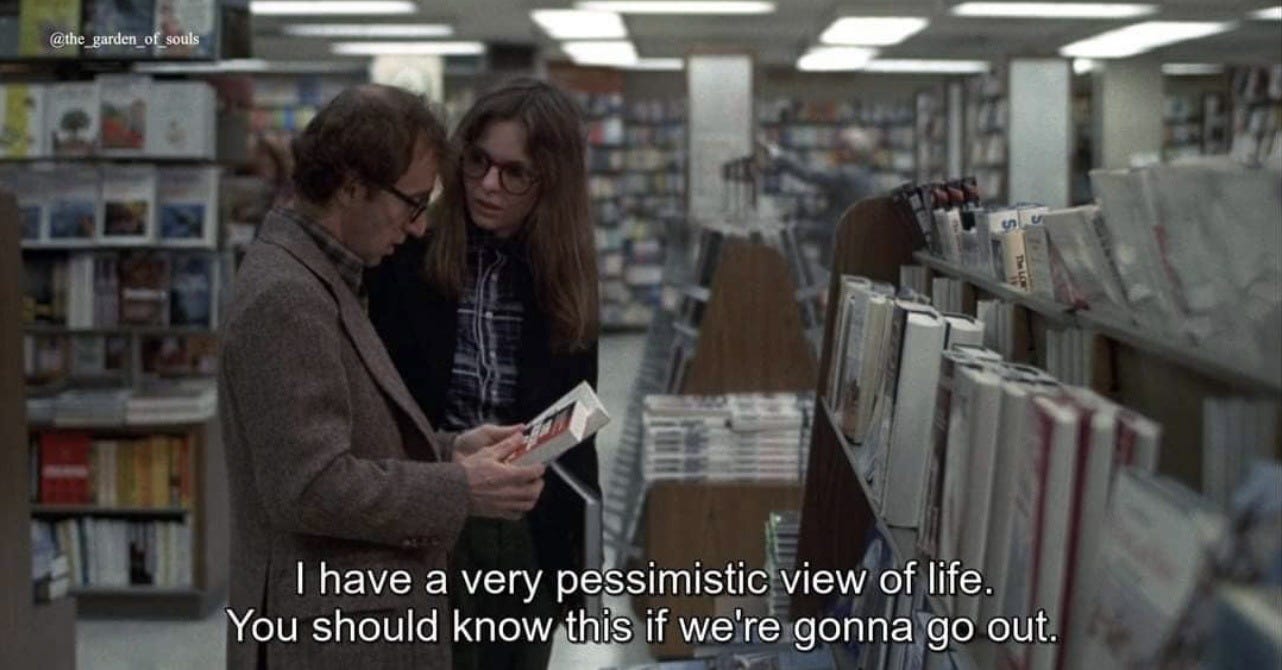
Already having a grim outlook on life, this is partly where some of Alvy’s pessimism comes from and makes him reevaluate whether he’ll continue to date. He wonders if it’s worth it, but he decides that “even though it’s totally crazy, irrational, and absurd,” he’ll keep doing it because he needs to believe he’ll find someone he’ll connect with just as much, if not more.
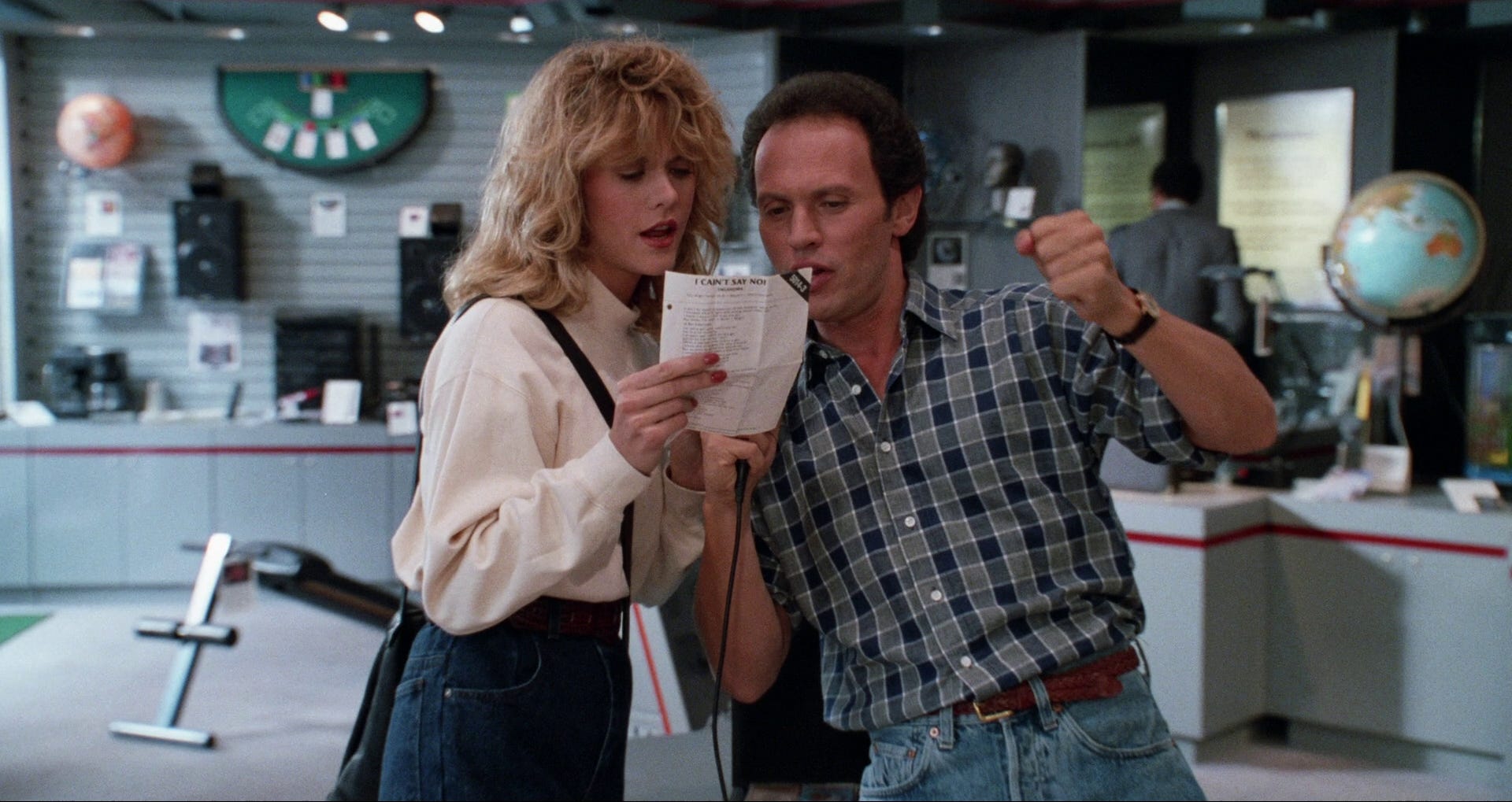
Like Annie Hall, when When Harry Met Sally was released in 1989, it also received a largely positive critical reception. It’s less cynical and more sentimental than Annie Hall. New York Times film critic Caryn James put it best when she described When Harry Met Sally as “the sitcom version of a Woody Allen film, full of amusing lines and scenes, all infused with an uncomfortable sense of déjà vu.”
In When Harry Met Sally, Harry (Billy Crystal) meets Sally (Meg Ryan) through his girlfriend because they’re both moving to New York from Chicago. They make the drive together, discussing relationships along the way. Harry doesn’t think men can be friends with women, especially a woman he finds attractive. "The sex part gets in the way,” he explains. Sally disagrees, and when Harry admits he finds her attractive in a diner, she angrily accuses him of coming onto her. When they get to New York, she drops him off in front of the Washington Square Arch, not expecting to see him ever again. However, they keep running into each other the years, eventually forming a friendship, though there is a sexual tension between them. It all comes to a head when Sally, upset over the fact that her ex-boyfriend is getting married, calls Harry and asks him to come over to comfort her. They end up having sex, which they both agree was a big mistake. But Harry can’t get her out of his mind, so he finds her at a New Year’s Eve party and declares his love for her.
A key flaw in When Harry Met Sally is that we never really know anything about these characters. They’re always on the hunt for “the one” so they don’t have to “go back out there” (go on dates). Their relationships keep failing, for some reason or another. All they talk about, either with each other or their friends, is their current relationship or their last failed one, even when they could be admiring masterpieces at the Metropolitan Museum of Art. What we do know about these characters are simply gender stereotypes.
Harry is a bit of a slob. He usually sleeps with his dates before getting to know them, even if he’s not attracted to her, and he often makes an excuse to leave within the hour after. He’s athletic; he likes sports; and he goes to baseball games, where he doesn’t talk about the game with his friend but about his failed marriage. Sally tells her friend that Harry is a political consultant, but he never spends much time working or even talking about it, other than being seen in a nondescript office.
Sally, on the other hand, is totally Type A, needing to have things just so. Unlike Harry, she needs to have a connection with someone before she goes to bed with him. A recurring sexual dream she’s had since she was twelve is of a face-less man ripping off her clothes. That’s it. It’s implied she’s a journalist because she got a degree in it, but she doesn’t seem to work much either. Most importantly, she wants to have a family (because all women want that), and it’s the catalyst to the break-up of her previous serious relationship. This leaves the characters just vague enough that everyone can relate to them.
Unlike When Harry Met Sally, Annie Hall reveals exactly who Alvy Singer is, and there are flashback scenes from his childhood, proving that he’s always been a neurotic little weirdo, worried about the expansion of the universe and frustrating his mother. Annie is a distinct character with likes, dislikes and a past: She’s from the Midwest with a Rockwellian family in comparison to Alvy’s loud and Jewish one; she wants to be a singer; and she likes L.A. more than New York. They seem like real people who might have existed in New York City during the 1970s.
The death of stand-up comedy begins when the comic tries to be cool, which applies to most comedy. Woody Allen has never pretended to be cool, and that makes Annie Hall a funny yet sometimes painful comedy of manners. He did present himself at his worst in order to free himself of his hang-ups, and it makes for a more vulnerable film. “Cool” is not the right word for Harry and Sally, but there is something a bit desirable about them, as they spend much of their time walking around Central Park, being good-looking. Woody Allen’s refusal to play it cool and the depth he gives his characters make Annie Hall a better, more insightful film than When Harry Met Sally.
I just haven't read anything contemporary about Woody Allen that made so much sense. Adam Gopniks piece about Allen from the late 90s sort of gets what I love about Allen's films, but this article, by its acute comparison, is extremely generative for thinking about the effect his films have as films. Truffaut also wrote a small piece about Annie Hall, which gets Annie Hall too. It's hard to believe how people dismiss Annie Hall, and people somehow prefer When Harry Met Sally, or even the Albert Brooks movies which I am yet to appreciate. Earlier today I read Penelope Gilliat's thoughts on Annie Hall, likewise wonderful. I hope you write more about Allen, and other films which are obviously influential, but scare people away from casual, insightful analysis for varied reasons. Thank you! Much enjoyed.
Agreed. I've never related to any character more than when Annie says, "Oh, god, Annie. Well, oh, well. Ha ha. La di da, la di da," and disappointedly walks out of the tennis club. I think about that scene at least once a week.